Showing posts with label processing:. Show all posts

07 October 2010

My Goggles and The Two Lost Sons


It’s crazy what being thoroughly immersed in Scripture can do for you, or should I say do to you.  John Calvin famously equated Scripture to being the eyeglasses by which the Christian is able to see the world.  My fuzzy logic then follows that the deeper and more immersed you are in Scripture, as we’ve been and will continue to be in Luke 15’s Parable of The Two Lost Sons, the thicker your spectacles will get.

I’m not bragging when I say that 3 solid weeks in, I feel like I’m wearing those nerdy coke bottle glasses.  I say this not because I’m a particularly good or dedicated reader or that I feel at all like I’ve got this parable pegged, but because, the more I’ve wrestled with this text and the more I’ve forced myself to come at it honestly the more God has surprised me.

As I’ve tried to put myself in the world of the parable, I’ve come to wonder about how each of the characters (Father, Prodigal, & Elder Brother) thought of themselves.  If they were introducing themselves at a cocktail party, what might they say? 

“I’m such-and-such and I’m so-and-so’s Father,” might be the reply of the Father.  And as far as I can tell, this reply is the only identity that doesn’t change throughout the story.  The younger brother tries with all his might to un-son himself and to un-brother himself.  And we find later on the Elder tries to do the same.  How is it that despite the fact that the family is being torn apart, the Father’s seems rock solid?  Why does what the Younger Brother do bother the Big Bro so much?  Why isn’t the Younger Brother content with just being in the family and having what he is related to who his Father is?  Why does he try and go it on his own?

Here’s where those bizarre new scripture shades come in for me.

So I was watching Survivor on tv (nice segue, right?!)…  This season features famed college and NFL football coach Jimmy Johnson along with other folks of various backgrounds, most of which were leaders in their contexts.  Insert someone with a bit of self-assurance, fame, and confidence and all but a few of them took him as a threat immediately.  It was bizarre.  Jimmy seemed content to be there for the experience, he certainly doesn’t need the cash, and in no way was an advantage written into the game for him.  Why did everyone care?  Why were they threatened by someone having fun?  Someone more interested in fishing, giving pep talks, and calling to wildlife than in game-play and outwitting his opponents?

It made me wonder what ways I try to make up my own identity (like the Prodigal), not being content with what and where I am?

It made me wonder what ways, when my identity gets pulled out from under me (like the Elder), that I start flailing and trying to take others down with me?

It made me want my identity to be grounded in the kind of confidence that Jimmy exhibited (certainly in a small and imperfect way) on the island.  It made me look back to Luke’s parable with more admiration for the love of that Father, whose love was so solid that neither being abandoned and un-Fathered or being doubted and pestered could budge.

Mostly it made me want to live into the steady-love of God in a more assured way.  In a way that grounds me and in a way that sends me out as an imitator.

What have you been seeing through the lenses of this parable?

05 July 2010

processing: Summer 2010 Reading (I)

For The Beauty of the Church
Ed. David Taylor
Since meeting a popular songwriter we hosted in college and being told to check out Steve Turner's Imagine, I've maintained a detached interest in the merger of theology and the arts.  As my theological mind has expanded, so too has my appetite for this intersection.  Duke's (by way of Austin, TX) David Taylor writes and edits this wonderful volume replete with talented and interesting authors and a panoply of perspectives.  Besides Peterson, who can hardly do wrong by me, I was surprised, edified and provoked by John Witvliet Worship piece (I look forward to thinking about original songwriting & worship with some amazing songwriters in our community) and especially Jeremy Begbie's musing on Art and Eschatology.  I highly recommend this to anyone who's ever even considered the role of art in the life of the Church.

Practice Resurrection
Eugene Peterson
The capstone to his prolific Spiritual Theology series, Peterson embarks on a thorough and serious treatment of growing up, being the Church, and living in terms of the resurrection existence Christ inaugurated, as articulated by the letter to the Ephesians.  I really appreciated how constructive this work was.  While providing harsh and prophetic criticism towards the failed and unfaithful ways we North American Christians attempt to build, progress, and grow, the tone and timbre of the whole matches the exciting, creative, and counterintuitive character of the great biblical letter it explicates.

Resident Aliens
Stanley Hauerwas and Will Willimon
About halfway through this book I really began to resent whoever chose our entrance reading requirements a couple years ago for Duke.  While Dean Well's Power and Passion was somewhat helpful, I can't really think of something else that could provide such a succinct and challenging primer to how things are thought and done at Duke than Prof. Hauerwas' and Bishop Willimon's landmark book.  I might have spoken louder, earlier, and more often in some precepts had I tackled this one prior to the summer before my final two semesters.  Spanning ecclesial ethics, the dangers of no-holds-barred modernism, and introing a Yoderian, post-Constantinian vision, these two master communicators also realize the importance of both eschatology and worship for the life of the Church in the world.  This work begs to be engaged with and achieves the provocation the cover advertises.

The Prodigal God
Tim Keller
I was really excited to dig into this one.  The final parable in the Luke 15 series has always been one of my favorites to read, preach, and re-evaluate.  This fall at Gathering Church, we're looking to focus on Keller's take.  His dealing stuck me as a bit unique, devoting a lot of space to the consideration of the older brother in the story (and going on to portray Jesus as True Elder Brother), going as far as to interpret him as but one of a couple of Lost Sons in the story.  I liked the accessibility and intrigue created by this.  It seems it will be a great entry point for those without a ton of study and small group experience as well as those, who know the story well.  It also made me go back to last summer's read: Volf's Exclusion and Embrace, to re-visit his brilliant exegesis of the characters within this keystone parable.  One main gripe I have is the  over-villianization of the Pharisee character in the story.  While I don't deny the teeth the the story has towards that crowd, the NPP-reader and Mel Gibson critic in me cringes at the careless portrayal of Jews as the epitome of flagrant unfaith.  All this said, I'll return back to Prodigal God (no spoiler alert: prodigal means extravagant, excessive) quite a bit more as a resource.

Deep Church
Jim Belcher
Anyone looking for some sort of positive assessment of the messy tangle encountering evangelical(-ish) church-life to come, should pick this one up.  Belcher offers an accessible and erudite survey of the landscape and painstakingly critiques and offers a way forward (which he, following CS Lewis coins the deep church).  This "third way," for him, is rarely a synthesis of the other two poles, though Belcher possesses all the charity, skill, and machinery to form such syntheses.  Belcher instead looks and, more often than not, finds a true new way.  This way of Orthodoxy and Engagement, truth and warmth, set-apartness and engagement must be the way forward and the type of leaders needed for such a grand endeavor must be committed to ecumenism, creativity, and generosity.  I thoroughly enjoyed this book.  It accurately mapped and widely conversed un order to generate a gravitational vision around the Triune God in community.  Well done.

17 February 2010

processing: Ash Wednesday- T.S. Eliot

Because I do not hope to turn again
Because I do not hope
Because I do not hope to turn
Desiring this man's gift and that man's scope
I no longer strive to strive towards such things
(Why should the aged eagle stretch its wings?)
Why should I mourn
The vanished power of the usual reign?

Because I do not hope to know again
The infirm glory of the positive hour
Because I do not think
Because I know I shall not know
The one veritable transitory power
Because I cannot drink
There, where trees flower, and springs flow, for there is nothing again

Because I know that time is always time
And place is always and only place
And what is actual is actual only for one time
And only for one place
I rejoice that things are as they are and
I renounce the blessed face
And renounce the voice
Because I cannot hope to turn again
Consequently I rejoice, having to construct something
Upon which to rejoice

And pray to God to have mercy upon us
And pray that I may forget
These matters that with myself I too much discuss
Too much explain
Because I do not hope to turn again
Let these words answer
For what is done, not to be done again
May the judgement not be too heavy upon us

Because these wings are no longer wings to fly
But merely vans to beat the air
The air which is now thoroughly small and dry
Smaller and dryer than the will
Teach us to care and not to care
Teach us to sit still.

Pray for us sinners now and at the hour of our death
Pray for us now and at the hour of our death.

14 February 2010

processing: Barth on Love (for Valentine's day)

This quotation from KB hangs on the bulletin board above our desk in the office:

"Love does not question; it gives an answer.
Love does not think; it knows.
Love does not hesitate; it acts.
Love does not fall into raptures; it is ready to undertake responsibilities.
Love puts behind it all the 'ifs' and 'buts,' all the conditions, reservations, obscurities and uncertainties that may arise between a man and a woman.
Love is not only affinity and attraction; it is union.
Love makes these two persons indispensable to each other.
Love compels them to be with each other."

(Karl Barth, CD III.4)

13 February 2010

processing: The Wild Rose- Wendell Berry

The Wild Rose
(written by Wendell Berry for his wife)

Sometimes hidden from me
in daily custom and in trust,
so that I live by you unaware
as by the beating of my heart.

Suddenly you flare in my sight,
a wild rose blooming at the edge
of thicket, grace and light
where yesterday was only shade,

and once again I am blessed,
choosing again
what I chose before.

04 February 2010

processing: Preaching, Praying & Paying Attention

The other day in preaching class we explored the link between preaching, praying, & paying attention. We heard from this beautiful poem by Mary Oliver (The Summer Day) which she manages to move from pondering the psalm-like wonder of created-ness to the child-like fascination with a particular bug and a particular fleck of sugar. I wish I had a more immediate link in my brain and worship between praying, paying minute attention, and falling on my face, "idle and blessed." Let this be the case with "this one wild and precious life." Amen.


Who made the world?
Who made the swan, and the black bear?
Who made the grasshopper?
This grasshopper, I mean--
the one who has flung herself out of the grass,
the one who is eating sugar out of my hand,
who is moving her jaws back and forth instead of up and down--
who is gazing around with her enormous and complicated eyes.
Now she lifts her pale forearms and thoroughly washes her face.
Now she snaps her wings open, and floats away.
I don't know exactly what a prayer is.
I do know how to pay attention, how to fall down
into the grass, how to kneel in the grass,
how to be idle and blessed, how to stroll through the fields,
which is what I have been doing all day.
Tell me, what else should I have done?
Doesn't everything die at last, and too soon?
Tell me, what is is you plan to do
With your one wild and precious life?

18 September 2009

processing: John Bunyan's 'Who Would True Valour See'

Who would true valour see,

Let him come hither;

One here will constant be,

Come wind, come weather

There’s no discouragement

Shall make him once relent

His first avowed intent

To be a pilgrim.


Whoso beset him round

With dismal stories

Do but themselves confound;

His strength the more is.

No lion can him fright,

He’ll with a giant fight,

He will have a right

To be a pilgrim.


Hobgoblin nor foul fiend

Can daunt his spirit,

He knows he at the end

Shall life inherit.

Then fancies fly away,

He’ll fear not what men say,

He’ll labor night and day

To be a pilgrim.


05 September 2009

processing: Tim Keller- The Reason for God: Belief in An Age of Skepticism

Catching up on posting for some of my end of summer reading:

I am intrigued by Tim Keller. He's one of those names that you here again and again as someone doing big things, and seemingly doing them the right way. Keller seems to combine intellectual rigor and appeal with pastoral concern and care, no doubt a proper cocktail for the urban ministry he heads.

While, generally proofs by reasoning and apologetic for God only marginally interest me (one can't afford ignore the Mere Christianity's & Simply Christian's), Keller's accessible and widely-read erudition holds great appeal. I don't know many "hot" Protestant ministers engaging with care and creativity minds and work from Flannery O'Connor to Niebuhr to Foucault.

Various Excerpts:
[referring to the charge of injustice and fanaticism] "What if, however, the essence of Christianity is salvation by grace, salvation not because of what we do but because of what Christ has done for us? Belief that you are accepted by God by sheer grace is profoundly humbling. The people who are fanatics, then, are so not because they are too committed to the gospel but because they're not committed to it enough (57)."

[referring to the response to Jesus' use of miracles in Matthew 28:17] "The most instructive thing about this text is, however, what it says about the purpose of Biblical miracles. They lead not simply to cognitive belief, but to worship, to awe and wonder. Jesus' miracles in particular were never magic tricks, designed to impress and coerce...Instead, he used miraculous power to heal the sick, feed the hungry, and raise the dead. Why? We modern people think of miracles as the suspension of the natural order, but Jesus meant them to be the restoration of the natural order (95)."

13 August 2009

processing: Miroslav Volf- Exclusion & Embrace

Perhaps my favorite element of this weighty work comes in Volf's careful and imaginative exegesis of Scripture in relation to the various images and metaphors he sets up for the processes of reconciliation. He masterfully supports his own devices not only through philosophical discourse (much of which is honestly lost on me), but through revisiting the stories of the Prodigal Son, the Syrophoenician Woman, the Passion narratives, and more. I also found quite useful and insightful his "double visioning" strategy for understanding others' point of view and determining best practice for love and conflict resolution. This work is rather weighty, but deserves the time, effort, and attention.

On our goal in using a "Double Vision":
"The most important theological reason for practicing double-vision lies not in the example of Jesus, but in the inner logic of the theology of the cross...on the cross God made space in God's very self for others, godless others, and opened arms to invite them in. The practice of double-vision...is the epistemological side of faith in the Crucified" (214).

"In a creaturely way we should try to emulate God's way of knowing. Not that we can crawl inside the mind of God and see things from God's panlocal perspective. But we can try to see the other concretely rather than abstractly, from within rather than simply from without. What human way of seeing corresponds to God's seeing "from everywhere"? Seeing both "from here" and "from there." Only such double vision will insure that we do not domesticate the otherness of others but allow them to stand on their own" (251).

On God's justice and grace:
"Consider, first, the foundation of the Christian community, the cross. Christ unites different 'bodies' into one body, not simply in virtue of the singleness of his person or of his vision, but above all through his suffering" (47).

"God's justice & God's kindness (Ps 145:17), God's righteousness & God's salvation (Is 45:21) are intertwined. When God saves, God does justice; when God does justice, God saves-unless one refuses to be saved. There is a profound 'injustice' in the God of the biblical tradition. It is called grace" (221).

On the Parable of the Prodigal (Luke 15):
"Departure was not an act of exclusion by which the self pulls itself out of the relationships without which it would not be what it is, and cuts itself off from responsibilities to others and makes itself their enemy" (158).

"For him [the prodigal] whose project was to 'un-son' himself and who is still in a distant country, 'sonship' can only be a memory, but it is a memory that defines his present so much that it sets him on a journey back" (159).

"Without the father's having kept the son in his heart, the father would not have put his arms around the prodigal. No confession was neccesary for the embrace to take place for the simple reason that the relationship did not rest on moral performance and therefore could not be destroyed by immoral acts. The son's return from 'the distant country' and the father's refusal to let the son out of his heart sufficed" (159).

On memory's role in forgiveness:
"In my memory of the other's transgression the other is locked in unredemption and we are bound together in a relationship of nonreconciliation. The memory of the wrong suffered is also a source of my own nonredemption" (133).


31 July 2009

processing: Summer Reading: Part II

No Country For Old Men- Cormac McCarthy
If you can believe it, McCarthy's writing is more haunting than the on-screen portrayal by Javier Bardem. Per usual, his writing is grim, violent, graphic. We are left to ponder the futility of our 'good fight'. Is there even such a thing? The protagonist drifts into the territory of moral ambiguity and we are left feeling disoriented when we realize that the serial killing bounty hunter possesses a singularity and ethic not found in the so-called 'good guy'. Through all this, the narrator, Sheriff Bell seems to be the only one willing to acknowledge the worlds (and his own) decline. Along with, The Road, this book should be on everyone's required reading.

Our Endangered Values- Jimmy Carter
Former President Carter seems to have uniquely improved his legacy more with his post-White House career and tireless advocacy than by anything he did as president. This account is an interesting combination of what else- politics and religion- the two things not to bring up. Knowing both President Carter's devotion to peacemaking and justice (through Atlanta's Carter Center) and his ongoing mediation in Baptist life (New Baptist Covenant & CBF), it is nice to get a firsthand account of his motivations and presuppositions. While I don't agree with him on everything, I admire his courage, incredible endurance, and unwavering posture of engagement and dialogue.

Know-It-All: One Man's Humble Quest to Become the Smartest Person in the World- A.J. Jacobs
I came across this one because I had read his A Year of Living Biblically and curiously enough picked it up at the same time as my friend Nick from church (and disc golf) was getting through it. Jacobs essentially chronicles his quest by picking out and occasionally revisiting the oddest, most profound, and down-right wackiest entries in the EB. What makes it interesting is his wit, candor, and occasional vulnerability when discussing insights from material as varied as Ecclesiastes and aquatic mating rituals. With Esquire-esque humour and agility, Jacobs manages to deftly weave his threads of familial relations, his wife and his struggle for fertility (and subsequent fatherhood), epistemology into a funny and reflective yearlong tapestry.

Jesus and Community- Gerhard Lohfink
Here are a couple insightful excerpts:
“If we ask Paul what significance the existence of the church has for pagan society in his writings...He says that God in Christ has reconciled the world to himself and that the church is now the place where reconciliation, which has already occurred in principle, is to be realized concretely. God has therefore charged the church with the service of reconciliation. The church is the place where, in a new creation, God has inaugurated reconciled society (pg 141).”

“Only in this gift of reconciliation, in the miracle of life newly won against all expectation, does what is here termed a contrast-society flourish. What is meant is not a church without guilt, but a church in which infinite hope emerges from forgiven guilt. What is meant is not a church in which there are no divisions, but a church which finds reconciliation despite all gulfs. What is meant is not a church without conflicts, but a church in which conflicts are settled in ways different from the rest of society. What is meant, finally, is not a church without the cross and without passion narratives, but a church always able to celebrate Easter because it both dies and rises with Christ (pg 147).”

unChristian:What a New Generation Really Thinks about Christianity...and Why it Matters- David Kinnaman & Gabe Lyons
I must say my favorite parts of this book were some of the first-hand insights from contributors at the end of each chapter. These contributors were as diverse as Jim Wallis, Rick Warren, John Stott, Rick McKinley, Churck Colson, Andy Stanley, Andy Crouch, & Shane Claiborne. A wide variety of evangelical voices and a great representation of the polyphony and variance under the umbrella of evangelicism. I remember, however, while reading, being both thankful and disheartened. Thankful that this research was done and that this book was written and pushed through a channel whereby it gets received by the largest possible needed audience. Disheartened that money and time was spent researching and writing to let us, evangelicals, those supposedly most concerned with and incarnate in the "outside, secular world," understand that we have a bad reputation and that reputation is built more on "our" hypocrisy, imperialism, prejudice, sheltered disconnect, & politics rather than "Christ and Him crucified."

Perhaps the most telling statistic was the results from a poll that revealed the disconnect between how the church's hospitality is received by pastors, regular born-again attenders, sporadic attenders, and the un-churched outsider:
Christian churches accept and love people unconditionally, regardless of how people look or what they do. (% who strongly agree)
pastors: 76%
born-again Christians: 47%
Christian churchgoers: 41%
outsiders (all ages): 20%
(pg185)
Blessed Are the Peacemakers- Wendell Berry
This short work pulls out key peacemaking passages (most prominently Matthew's Sermon on the Mount) dealing with living peaceably. Finally there is an essay, previously published in the Christian Century, titled, "The Burden of the Gospels," that seeks to synthesize these passages.

Here are a couple excerpts:

"When Jesus speaks of having life more abundantly, this, I think, is the life he means: a life that is not reducible by division, category or degree, but is one thing, heavenly and earthly, spiritual and material, divided only insofar as it is embodied in distinct creatures. He is talking about a finite world that is infinitely holy, a world of time that is filled with life that is eternal. His offer of more abundant life, then, is not an invitation to declare ourselves as certified "Christians," but rather to become conscious, consenting and responsible participants in the one great life, a fulfillment hardly institutional at all."

"If we take the Gospels seriously, we are left, in our dire predicament, facing an utterly humbling question: How must we live and work so as not to be estranged from God’s presence in his work and in all his creatures? The answer, we may say, is given in Jesus’ teaching about love. But that answer raises another question that plunges us into the abyss of our ignorance, which is both human and peculiarly modern: How are we to make of that love an economic practice?"

God Has a Dream- Archbishop Desmond Tutu
Like No Future Without Forgiveness only much, much lighter. Archbishop Tutu elaborates on the theology that roots his reconciliation efforts in South Africa over the past several decades. This theology enlists the African concept of Ubuntu, a shared humanity, the recognition of the image of God in the other. Endearing and self-deprecating at times, he begins each chapter, "Dear Child of God..." From then on you are engaged and edified by this wise, gentle, and incredibly experienced man. Catching a vision for "Hope in our Time," seems like a worthy pursuit, Tutu's contribution is helpful.

The Sacredness of Questioning Everything- David Dark
I really enjoyed this one. A pleasure: well-written, witty, and penultimately relevant for current popular Christian discourse. Something like a Christian Chuck Klosterman. This is kind of a grown-up Blue Like Jazz, the book that you might loan to someone only peripherally interested in God and spirituality, but culturally, academically aware. From his detailed exegesis of Arcade Fire songs, to his unswerving devotion to Steven Colbert's prophetic truthiness, Dark manages to produce a work both religiously and culturally discerning, and at times critical. Dark bridges the gulfs of his current Vanderbilt PhD pursuit (and talks the talk quite nicely) and his gig teaching English at a conservative Nashville Presbyterian high school. What you get is an account that asks the right questions, provides only some of the answers, lets you do the work and prayer to come up with the rest, and hails the process of loving the Lord with our heart, soul, mind, strength, and questions.

Portrait of Calvin- T.H.L. Parker
[available for free digital download at Desiring God.]
I read this biography to celebrate JC's (the less famous/divine one) 500th birthday this month. I also thought it might be nice to get someone else's than Steinmetz' account of Calvin, after all the good Doctor is an unabashed Luther man. The most striking and personal note struck came in the first few pages in regard to Calvin's choice of education. It seemed obvious for him to go to Paris to study Theology at what was considered the orthodox and best option. Instead he chose to study law elsewhere. "...the intricacies and niceties of the law was gained which he could never have won from the University of Paris. At Orleans and Bourges, the intellectual atmosphere was more free. New ideas were not bogies, but food for interesting speculation. The classics...now seemed most desirable- calling, not to danger, but to delights." This portion both particularly resonates with me and the path I've taken in my graduate studies, and strikes me with a certain sad irony that Calvin's delight came in the freedom and curiosity not as widely afforded in some modern institutions that hail his thought.

Related: SUMMER READING: PART I.

23 July 2009

processing: At the Helm, Out of My Depth

The following is my second field education reflection group paper, concerning the second half of my Roxboro, NC placement.

At the Helm, Out of My Depth
The age-old image of the Church as a ship has begun to make sense to me. Kind of a “we’re all in this together,” afloat-through-the-storms-&-turbulence type of reasoning. That image is both romantic and frightening. Even more frightening is the realization of pastorally helming such a ship. My turn with the captain’s hat and wheel came over a two-week period whereby my supervisor left the country and left me to steer us down the center.

A couple weeks prior I got my first taste of what, according to Murphy’s Law, could and often does happen. While taking some of the youth (in fact a record number of youth: two full car-loads) to a summer movie special at the local cinema, we got in an accident. I say we, but mean rather four small children and the church matriarch, whom I enlisted to drive. Suffering a vicious sideswipe on a busy separated highway, I watched helplessly in the real-time panorama of a gruesomely violent crash. As I ran to the wreck, my heart pounded and mind raced. No training or preparation readied me for the response required of me. There was a dual awareness in me: a power and certainty, but also a frenetic awkwardness and hesitancy. Like the Platonic horses, I attempted to reign in both competing energies in order to be fully present and helpful in the situation in my midst.

After a day of holding up emergency room walls and wearing ruts into hallway floors, I departed Person Memorial encouraged, but troubled. Encouraged and thankful that none of my charges were seriously or permanently injured, but troubled by what had happened. It seems natural that we get shook up and called to refocus after avoiding an accident. If it was going to be our fault, we reevaluate how we were driving and how we must be more vigilant. If it was to be the other driver’s fault, we let angry thoughts flit across the clarity gained by the mix of adrenaline and awareness. What was troubling here though was that there was an accident. There was a sharpness. There was a momentary disorientation followed by an extreme sense of calm and clarity. But having seen the elderly, Alzheimer-riden antagonist confused in the backseat of the patrol car, there was no anger. That lack of anger was confusing and disorienting in itself.

Fast-forward a couple weeks, past the barrage of rental cars and CT scans, the only remnants of the bruises are now but pale-yellow traces. I am handed the reigns. My supervisor is now six time zones away and I begin an intense battle for both ministerial respectability and my beloved, well-ordered 5-day workweek. That fight began in earnest as I wrapped a 3rd of July barbeque and received a frantic phone call from the aforementioned driving matriarch-turned church liaison. It appeared that, as anyone may assume, the ills and injuries had saved their worst for the worse possibly timing, now. I left the celebration to attend to my parishioner, who suffered an aneurism. The contrast only became more apparent as I reached the bedside: my flip-flops and summer attire accusing the stifling white everything. Why did this aorta, as if on a timer, chose now, a time so festive and light; a time so unprepared and unfocused?

The following ten days featured more visits to Duke Hospital and anxious hikes from Central parking than I would have ever expected. What made the hikes especially anxious was the overwhelming feeling of unpreparedness, the fear of failure, and the nervous tension of not knowing. My visits featured long-periods of silence, awkward prayers, wanna-be tender embraces, over-stayed welcomes, and over-stepped boundaries. Just what to do when you don’t understand the seriousness and risk of the surgery to be performed and everyone else does but won’t admit it? What to do when you can’t communicate with the pacing fifty year-old son long enough to figure out what the family actually needs? To extend the nautical metaphor, wait out the storm. Don’t give up patience, don’t over-correct.

Throughout these varied incidents in my time at the helm, I found great comfort and instruction, perhaps “a peace surpassing understanding,” from the God who both creates and calms storms. Through the turbulence of car-crashes, self-blame, heart surgery and elephants in the room, I was consistently interrupted both by an overwhelming gentle stillness and a certain mantra of, “Peace. Be Still.” It was through these promptings and certainly not through neither some innate ability nor heroic confidence that I was able to offer even a modicum of stillness and peace to these families. Though out of my depth and completely unprepared, I learned my role was to merely offer the peace that I had been given.

19 July 2009

processing: Luke's "Our Father" (Luke 11)

As we've been talking at church about gathering and what it means and looks like to gather around Jesus, I've been struck by the Third Evangelist's record of the "Our Father prayer". We're certainly used to the Matthean version, and usually only waiver on whether to say trespasses or debts.

"Father, hallowed be your name.
Your kingdom come.

Give us each day our daily bread,
and forgive us our sins,
for we ourselves forgive everyone who is indebted to us.
and lead us not into temptation."
Luke 11:2-4 (ESV)


Gerhard Lohfink astutely observes in Jesus & Community some of the grammatical and syntactical devices that allow for a translation of the first two lines as: "Father, Sanctify Your Name! (passive 3rd singular), Bring about your Kingdom!" Peterson's The Message paraphrases it as: "Father, Reveal who You are!, Set the world right!" It is with these considerations along with the larger witness of the gospel (especially this gospel aimed toward a Gentile audience and in conjunction with its "sequel", Acts) that we must form our imagination of what it means to be a community that gathers around Christ.

More to come later this week.

20 June 2009

processing: Mark Noll- The Scandal of the Evangelical Mind

This historical survey's brilliance lies in its relevance for our present and future. We must understand where we've been to fully appreciate (/deprecate) where we are and to give us insight into what courses we chart. Noll's writing is both polemical against grievous mistakes the evangelical community has made and pastoral and hopeful of the recourse available. Here is an excerpt that gives insight into his conclusions and advice:

"If God devoted so much of himself to the created realm-in order to purchase the redemption of sinners- is it imaginable that sinners who enjoy the salvation won in that realm might seek more diligently to fathom the realities of that realm- in order to worship their Redeemer?

That possibility is more than just a play on words. Redemption, which evangelicals often consider a means for God to rescue us from this world, was carried out (and is being carried out) in this world.

That reality should not diminish the larger reality of heavenly or eternal existence. Neither should that reality lead to the mistake at the other end of the spectrum, where eagerness to understand the workings of the world becomes an end in itself. John Calvin pit it well when he said that “the human mind is…a perpetual forge of idols.” The solution to idolatry, however, is not to destroy all the material from which idols are made. The solution is to treat the material from which we construct idols appropriate to its reality. The wood and stone from which idols are made do not deserve to be worshiped; because God made them, however, they deserve to be studied as wood or stone.

Once again it is worth stating the central point. The life of the mind is not necessarily superior to any other legitimate human pursuit. But it is a legitimate human pursuit (242)."

30 May 2009

processing: Summer Reading: Part I

The Omnivore's Dilemma: A Natural History of Four Meals- Michael Pollan
Michael Pollan writes a comprehensive account of 4 modes of eating. It is written smartly (sometimes snarkily so) and the quest-journalism side of me loves the humor and experiential vulnerability displayed. The 4 modes covered are: big box/industrial fast food, industrial organic, local, & hunter-gatherer. Highlights include his interview with Northern VA's Polyface celebrity Joel Salatin and his hunting/shrooming escapades in Northern California. It is interesting some of the conclusions reached here. There is not a free pass afforded to the Whole Foods lifestyle, nor is he regretfully idealistic about hunting wild boar and collecting sea salt and scallops in the Pacific. This book is a solid read, allowing you a philosophical, practical, economic, political, and culinary look at just what is going into your body and what it takes to get it there.


Same Kid of Different As Me- Ron Hall & Denver Moore
These two amateur authors combine for a decently constructed autobiographical narrative about reconciliation, God's providence amid both grinding poverty and rampant selfishness, and the ability of the Holy Spirit to form bonds and relationships that wouldn't be possibly through any other means. Ron is an international art dealer, rolling in cash, subjecting his marriage to the damage of infidelity and the hollowness of materialism. Denver is a former share-cropper (read: modern day slave) turned violent and psychotic homeless man. The two lives emerge through a long forming relationship at a shelter and like any good missions project, the "missionary" emerges changed and taught more than the "mission to be accomplished". If you can wade through some clumsy and often cheesy storytelling, this book is a helpful, touching, and at times heartbreaking tale.


A Generous Orthodoxy: Why I Am A...Christian- Brian McLaren
This one was one of those nagging reads that you feel you need to take a peak at, glean some really positive things, be displeased with some others, but generally come out the better for having powered through. I'll be honest, my first skepticism came from the repeated assurance that the Emergent Church (dunno if caps are needed) need not rely on personalities while McLaren's neutral post-modern mug peers at you from the cover. Then I remember not to judge a book by its cover but rather by its overly long and pretentious subtitle (that's fair don't you think?). There were several parts (in fact most of the book) that I really enjoyed, lined up well with, and feel confident in though. Brian's emphasis on balance, a health patristic appreciation and ecclesial unity and generosity rang loud and clear. I'll continue to keep an eye on McLaren, he seems to be on to something and deserves the hermeneutical generosity he demands.


Durham Tales: The Morris Street Maple, the Plastic Cow, the Durham Day That Was & More- Jim Wise
Only a town as self-conscious, wacky, and unique as Durham could have a history of such equal qualities. Wise attempts a folky and at times humorous incomplete history of our beloved stepchild of a city. By choosing diverse, minor, and utterly absurd episodes, he, like any good historian, demonstrates exactly why things are the way the are. Bright spots include the geographic beacon of the Morris St maple, the trainspotting recurring throughout the pages, minor characters ranging from the neighborhood mom to the sportsmanship-touting coach, and of course all of the standard players (Dukes, Watts, etc.) that clue us in what has made and continues to make the Bull City tick. If you don't live in or around Durham, do some work and find somehting like this for your town, it will further embed you in it and certainly increase your appreciation and/or sympathy for your surroundings.


The Memory of Old Jack- Wendell Berry
I would recommend one of Berry's Port William Township novels to anyone looking for beautiful prose describing menial happenings. By menial I mean there are no dramatic twists and turns, the characters are common folk in a small town, the novels are not sequels because there's not a plot to advance. Instead these memoirs (of the town more than the actual characters) display tragically, vividly, and carefully the depth of the membership. The Memory of Old Jack narrates the senile patriarch's past and present in heart-breaking terms detailing his doomed marriage, the devastation of a still born child, the awkward relations in a tenant labor system, and everything else that comes with growing old. Like his brilliant essays, Berry displays his passion and penchant for teaching and transmitting difficult topics and subjects in homey, endearing, and provocative terms. This particular book proved valuable to me in my start of field ed, while it describes rural KY, the dynamics parallel Roxboro, NC closely, and the care and respect given to the characters fosters likewise respect for the hardworking simple folk I encounter daily.

Becoming The Answer To Our Prayers- Shane Claiborne & Jonathan Wilson-Hartgrove
Shane & Jonathan have a precious gift for presenting practical teaching in a candid, comical, and subversive tone. Like their previous works/appearences, they use plenteous personal experiences and interactions to share the counterintuitive good news of Christ and the discipleship required of his followers. Having been over to Rutba and hearing both of these gentleman, you immediately understand a depth in their testamony beyond their words. Their words are secondary to their daily authenticity. If you have a chance, meet them. They are humble, funny and hospitable: as advertized. In this short volume, they tackle prayer: the Lord's Prayer & Jesus' Prayer for unity (Jn 17). Not unlike the exhortation in Jame's Epistle, they teach a seemless and inextricable bond between our prayers and the action resulting from our prayers (think less 'self-fulfilling prophesy' and more of an intergrated 'active spirituality'). The goal then is not to pray our way out of this world, but rather praying to become (and then actually becoming) a part of God's work for the redemption of the world. These prayers are subversive and dangerous prayers, but neccessary and powerful.

18 March 2009

processing: Teresa of Avila- The Interior Castle

The first thing I admire about Teresa after reading this overly verbose mystical classic, is the question posed to us by our preceptor concerning the author, "In the midst of the Catholic Counter-reformation, was Teresa a Good Catholic or a Good Protestant?" Exploring this question yielded no easy answer and no decisive conclusion. I like this about Teresa. I like that the Catholic Church (then, and by extension, the "Church" now) was big enough for her differing methods, eccentricity, and faithful dissent. I also admire the "reforms" she and the rest of her Spanish contemporaries enacted (Ignatius, St. John of the Cross...). Most of these had less to do with published treatises and more with creative and passionate pursuit of God. We can't all necessarily agree on every point of her theology, but there is no denying the humility, experience and discernment present in her life with God.

"Let nothing trouble you
Let nothing make you afraid.
All things pass away. God never changes.
Patience obtains everything. God alone suffices."
Solo Dios Basta

27 January 2009

processing: Stanley Hauerwas & Jean Vanier- Living Gently in a Violent World

I read this book and really liked it, and think it is really important. The idea and message has really gotten legs around my school. Instead of me neglecting my schoolwork to write a review, I'll link to an NPR interview that aired today:

http://wunc.org/tsot/archive/sot0127bc09.mp3/view

10 January 2009

processing: Rob Bell- Jesus Wants To Save Christians: A Manifesto for the Church in Exile

(this post is indicative of Bell's writing style, take a look next time you're in Borders)

Bell, regardless of whether or not you agree with him on every detail or viewpoint, is a great provocateur in his sphere.

The general message and the interpretive tools he used are not all that cutting edge for academia and Christendom in general.

But they are

for us:

in the West,

in the 21st century,

as part of a potential empire (who doesn't in every circumstance consider itself an empire except for when it is beneficial or convenient).

And as conservative (yes, he is still rather conservative as far as academia goes) and a Zondervan author;

I applaud him. For his guts, soundness, creativity.
I also applaud Zondervan for publishing titles like his, Shane Claiborne's, and a few others that push the envelope for their target audience.

Professor Ben Witherington III says about Bell, "Rob has a considerable gift of being able to speak clearly and directly even about complex theological and ethical concepts, and he understands the need to tease the mind into active thought."

I recommend this book. It makes you think. It points out some things you may have never considered in Scripture, in our culture and abroad. Read discerningly and respond accordingly.

28 December 2008

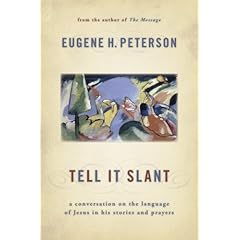
processing: Eugene Peterson- Tell It Slant

This 4th (I believe out of 5) installment in Peterson's Spiritual Theology Series picks up quite nicely where the previous 3 leave off.

[previously: Christ Plays in Ten Thousand Places, Eat This Book, The Jesus Way]

The title comes from a well known Emily Dickinson quote, "Tell all the truth but tell it slant."  The subject is the conversational language, parables, and prayers of Christ.  Just this fall as I got the tips of my toes wet with Biblical Greek, I gained an appreciation and understanding for parables as stories "thrown alongside" (para- along side, ballo- I throw).  Peterson, like few I know weaves together, prophetic wisdom, scholarly precision, poetic license, and pastoral gentleness into a seamless teaching that brings you closer to the heart of Christ's person, teaching, and ministry.

Here are a few poignant excerpts:

"The parables are basic verbal defenses against disengaged complacency."- pg 68

"We do not become less needy, less dependent when we pray; we become more needy, more dependent- which is to say, more human.  When we pray we dive ever more deeply into the very human condition from which sin alienates us and Christ saves us."- pg 55

"...but however wonderful and accurate my early learning of glory, it was quite without rootage in my life.  And it is rootage I am after: rootage as I go to worship and to work, rootage as I read the newspapers and talk with my friends, rootage as I vote in elections and buy tires for my car, rootage as I get cancer and have surgery and convalesce, rootage as I accumulate birthdays and anniversaries, rootage as I write letters and read books."- pg 208

"Praying Jesus' forgiveness prayer trains our spirits in compassion, not revenge; in understanding, not irritation; in acceptance of a brother or sister sinner, not rejection of a neutered alien.  It also makes room for the possibility that 'they know not what they do.' More specifically that they do not know that they are hurting or defiling an image of God, that they do not know that they are defrauding or maiming 'one of the least of these who are members of my family' (Matt. 25:40)"- pg 247

"Misunderstanding and indifference are, like the poor, 'always with us.'"- pg 202

"And so-thanksgiving.  Not just for wildflowers and butterflies, for the moonlight on a blanket of snow, for the athletic grace and symphonic sound.  Thanksgiving is certainly appropriate for all that gives witness to goodness and truth and beauty, and so it doesn't surprise us when it is given under these favorable conditions.  But Jesus' thanksgiving surprises us.  Jesus' geyser of thanksgiving is honey in the rock."- pg 203

15 December 2008

processing: Emmanuel Katongole & Chris Rice- Reconciling All Things

This Intervarsity Press release marks the first in a series of books released in conjunction with Duke's Center for Reconciliation. The co-authors are also the co-directors of the Center. The goal of the series, marked in this book, an extended thesis statement of sorts, is to pair a leading theologian (in this case Katongole) and a leading practitioner (Rice) to provide a well-conceived and faithfully produced angle on reconciliation. The pairings take reconciliation our from the ivory towers or from behind the pulpit and put it firmly in the middle of real life and situations. Katongole, a Catholic priest, Vatican-educated and theologically-adept, merges experience and worldly insight with Rice's (a lay Presbyterian) personal testamony of deep-south racism and recovery. This book lays the groundwork for what could be a very important series and topic in Catholic, mainline and evangelical circles in the near future. Volume 2 was recently released (L'Arche's Jean Vanier and Duke's Stanley Hauerwas Living Gently in a Violent World) and upcoming titles have names like Christine Pohl and Christopher Heuertz. Keep an eye out for all of these accessible, important, sensitive, and potentially paradigm-shifting books!

24 November 2008

processing: Kary Oberbrunner- The Fine Line

With this Jan 2009 release, Kary further investigates the useful paradigm he set up in Journey Towards Relevance. A constant struggle for many Christians (especially in evangelical circles) is just how to be faithful to a Holy God while living our God's command to love our neighbor and Paul's example of being "the all to the all"; how to be salt and light. Kary offers visual insight with the simple, though certainly not simply applied, analogy and model of a see-saw.

This is a great primer to get youth and undergrads a taste of some difficult philosophical questions we must ask ourselves in order to hold up the dialectic of dove-like innocence and serpentine discernment. Further reading, though not required, could certainly be introduced in this book. I commend Kary for bringing some of the vital arguments told several years ago from the ivory tower of academia by H. Richard Niebuhr. Dr. Niebuhr is rarely able to penetrate the halls of a high school youth group or an intercollegiate ministry though. Kary is able to start these conversations faithfully, gracefully, thoughtfully and humorously. As has been proven time and time again, "Tell all the truth but tell it slant." Kary's new book provides a truthful slant on an extremely relevant and necessary pursuit: loving God, loving people and reconciling the two.

amazon

reftagger